What Is an AI Agent? A Beginner’s Guide
🤖 1. What Is an AI Agent?
Most people have heard of AI tools such as ChatGPT, Google Gemini, and Claude. We can ask these AI systems questions, and they can understand our instructions and generate useful responses.
Instead of only generating a response, an AI Agent can be designed to understand a goal, decide what steps are needed, use tools or external information, and take actions to accomplish that goal.
🌦️ A Simple Example
Imagine asking an AI system:
“Find today’s weather and tell me whether I should carry an umbrella.”
💬 A simple AI response: It may provide an answer based on information already available to it.
🤖 An AI Agent: It could obtain the current weather information using a weather tool, examine the result, and then provide a recommendation based on that information.
An AI Agent can work through a task using information, decisions, tools, and actions rather than simply producing a single response.
In this beginner-friendly guide, we will understand what AI Agents are, how they work, where they are used, and how they differ from traditional chatbots.
Later in this series, we will build simple AI Agents using Python and learn these concepts step by step.
2. 💡 AI Agent definition
Now that we have seen a simple example, let’s define an AI Agent in straightforward language.
An AI Agent is a software system that uses AI to understand a goal, make decisions, use available tools, and take actions to accomplish that goal.
To understand this definition, focus on the important words:
In simple terms, an AI Agent does not just give you information. It can work through a goal by deciding what to do next and using the tools available to it.
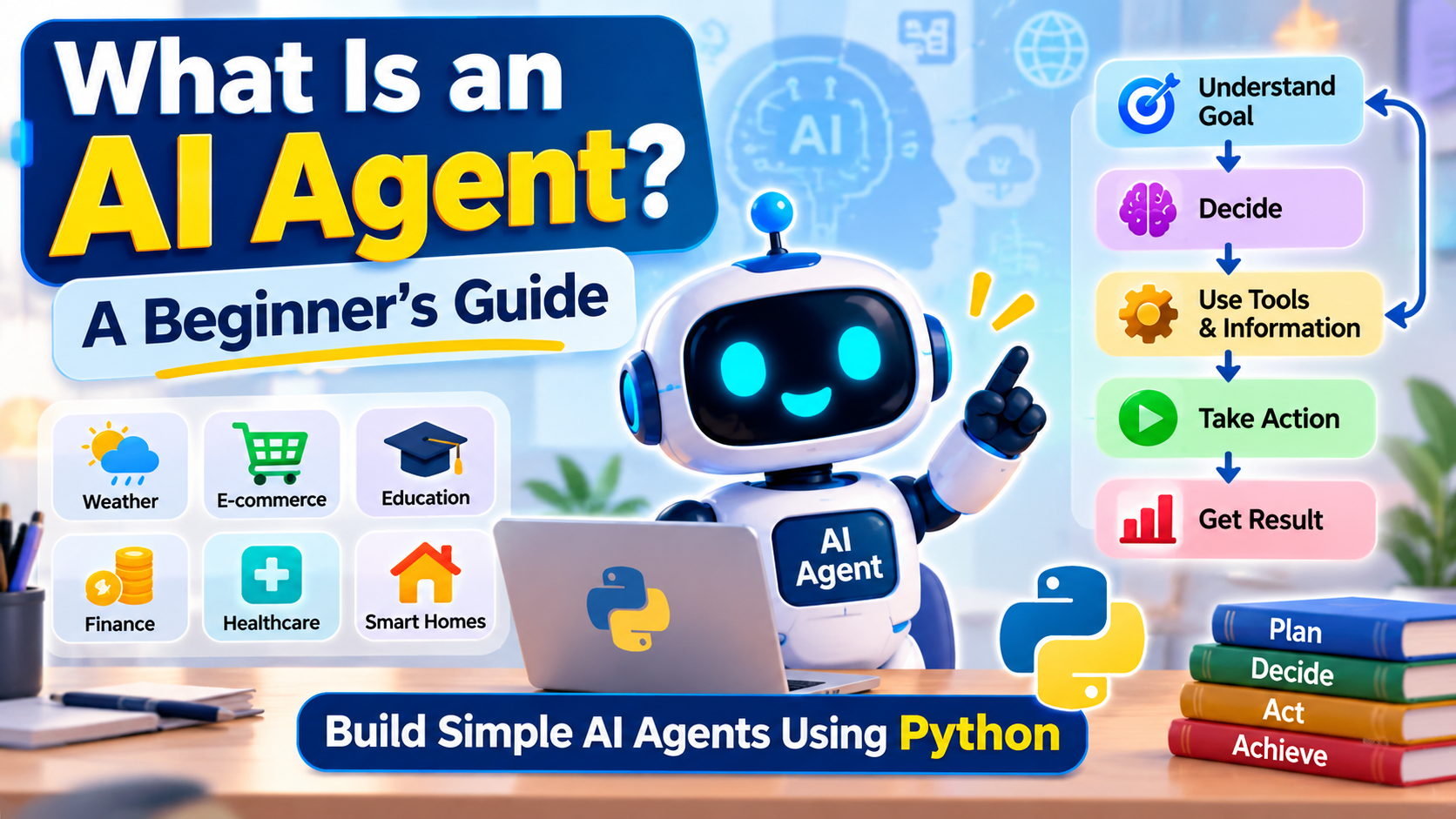
Goal → Decide → Use Tools → Act → Result
This simple flow will be the central concept throughout this AI Agent series.
3. 🔄 Understand an AI Agent with a Simple Diagram
The easiest way to understand an AI Agent is to look at the flow of how it handles a request.
🌦️ Let’s See the Same Idea with an Example
“Find today’s weather and tell me if I need an umbrella.”
This visual approach helps beginners understand what an AI Agent does before introducing technical terms such as LLMs, automation, planning, tools, or function calling.
4. 🧩 The Four Basic Parts of an AI Agent
A simple AI Agent can be understood using four basic parts. You don’t need to learn the technical details yet. First, understand what each part does.
🧠 1. Brain
Usually an AI model or LLM.
It understands the user’s request and helps the agent decide what to do.
Examples:
- GPT
- Gemini
- Claude
- Other AI models
🎯 2. Goal
The agent needs something to accomplish.
Examples:
🛠️ 3. Tools
Tools allow an AI Agent to get information or perform tasks outside the AI model itself.
Examples:
- 🌦️ Weather tool
- 🔎 Search tool
- 🧮 Calculator
- 📁 File or database access
⚙️ 4. Action
After understanding the goal and gathering the required information, the agent can take an action to move toward the result.
For example, it might search for information, calculate a value, retrieve data, send a message, or provide the final answer.
5. 🤖 AI Agent vs Chatbot
This is one of the most important ideas to understand before learning how AI Agents are built.
In very simple terms, a chatbot mainly focuses on conversation, while an AI Agent can work toward a goal by deciding what steps are needed and taking actions.
| 💬 Chatbot | 🤖 AI Agent |
|---|---|
| Mainly responds to users | Can work toward a goal |
| Usually generates an answer | Can decide what steps are needed |
| May only use conversation | Can use external tools |
| Usually waits for the next message | Can perform multiple steps |
| Example: Answer a question | Example: Search → analyze → calculate → respond |
🌍 Real-Life Examples
You ask:
The chatbot reads or generates an appropriate response and gives you the information you requested.
You ask:
Depending on the system’s available tools and permissions, an AI Agent could:
- Find the order information.
- Check the relevant return information.
- Determine the next steps.
- Give you a useful response.
The difference between a chatbot and an AI Agent is not always absolute. Modern chatbots can also use tools and perform actions, so the two terms can overlap.
In this series, we use “AI Agent” to mean an AI system that can understand a goal, decide on steps, use tools, and perform actions.
6. 🌦️ A Very Simple AI Agent Example
Let’s put everything we have learned so far into one simple example. Imagine a weather agent whose job is to help you decide whether you need an umbrella.
🤖 What does the AI Agent do?
The agent did not simply generate a sentence. It used information and performed a sequence of steps to work toward the user’s goal.
7. 🔄 Understanding the Basic AI Agent Loop
One of the most important ideas to understand about an AI Agent is that it may not complete a task in just one step. It can work through a loop until the goal is achieved.
A simple version of the Agent Loop looks like this:
🔍 What happens at each step?
The agent can repeat the cycle when the goal has not yet been achieved. This repeating process is called the Agent Loop.
Suppose the goal is to find suitable weather for an outdoor event. The agent can check the weather, examine the result, and decide whether more information is needed. If the goal is not complete, it can take another step.
8. 🤖 Not Every AI Agent Is Highly Autonomous
The term “AI Agent” is sometimes made to sound more powerful than it really needs to be. An agent does not necessarily have to be a completely independent AI system that can do everything by itself.
An AI Agent can be very simple. It may perform only two or three predefined actions, or it may handle a much more complex task involving many tools and steps.
🔹 Agents can have different levels of complexity
Performs a small number of predefined steps to accomplish a specific task.
May use several tools, make decisions at different stages, and perform many actions before completing its goal.
Imagine a small weather agent whose only job is to check the weather and tell you whether carrying an umbrella would be useful. It does not need to control your entire day or make dozens of independent decisions to be considered an AI Agent.
Our first AI Agent project will be intentionally simple. The goal is to understand how an agent works before moving to more advanced agents.
9. 🚀 Your AI Agent Project Series
Now that you understand the basic idea of an AI Agent, the best way to learn is to build agents gradually.
Instead of starting with a complicated framework, we will begin with a small Python project and add new capabilities step by step.
A very basic Python agent that receives a request and decides between a few predefined actions.
Add tools such as a calculator or custom Python functions.
Allow the agent to obtain information from an external source or API.
Build an agent that can perform several steps to accomplish a larger task.
Build a small useful application that combines the concepts learned in the previous projects.
This gives you a clear learning path instead of throwing a complicated AI Agent framework at you immediately. Each project builds on the ideas learned in the previous one.
10. 🌍 Where Are AI Agents Used?
AI Agents can be used in many areas where a task requires understanding a goal, making decisions, using information, and performing actions.
For example, an AI Agent can answer customer questions, help students learn a topic, find errors in a program, search for information, manage tasks, or help prepare a report.
💼 Some Common Areas
An AI Agent becomes particularly useful when a task involves multiple steps rather than simply providing a single answer.
Suppose a student asks an AI Agent: “Find the error in my Python program and explain how to fix it.”
Depending on its available capabilities, the agent could examine the code, identify a possible problem, explain the issue, and suggest a correction.
AI Agents are useful when an application needs to move beyond simply answering a question and needs to work toward a goal through one or more steps.
🚀 What Will We Build in This AI Agent Series?
In this series, we will learn about AI Agents by building simple projects step by step.
We will start with a basic Python AI Agent that can understand a user’s request and choose an appropriate action.
Then, we will gradually add useful features such as tools, external information, decision-making, and multi-step tasks.
Each project will introduce one new concept, so you do not need advanced AI or Machine Learning knowledge to follow the series.
By the end of the series, you will have a practical understanding of how AI Agents work and how to build a basic AI Agent using Python.
In the next post, we will start with a very simple Python AI Agent and see how the basic idea works in practice.
🎯 Conclusion
AI Agents are software systems that can understand a goal, make decisions, use tools, and take actions to accomplish a task.
Unlike a simple program that follows a fixed sequence of instructions, an AI Agent can decide what steps may be needed to reach a desired result.
In this article, we explored the basic idea of AI Agents, how they work, where they can be used, and how they differ from traditional chatbots.
In the upcoming articles, we will move from concepts to practical projects and build simple AI Agents using Python, one step at a time.