Periodic and Non-Periodic Signals – Questions and Solutions
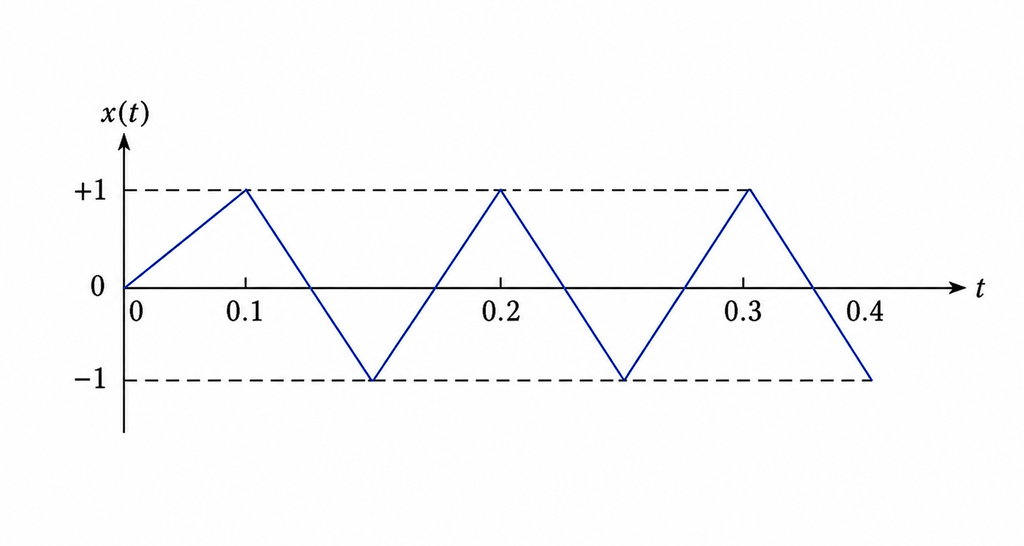
Q1. What is the fundamental period of the waveform shown below figure?
Sol:
The given signal is a triangular wave which starts at t = 0 and again starts at t = 0.2.
∴ Period, T = 0.2 − 0
= 0.2 sec
Note:
Fundamental frequency, f = 1/T = 1/0.2 = 5 Hz
If we want to express fundamental frequency in rad/sec,
ω = 2πf
= 2π × 5
= 10π
= 10 × 22/7
= 31.4 rad/sec
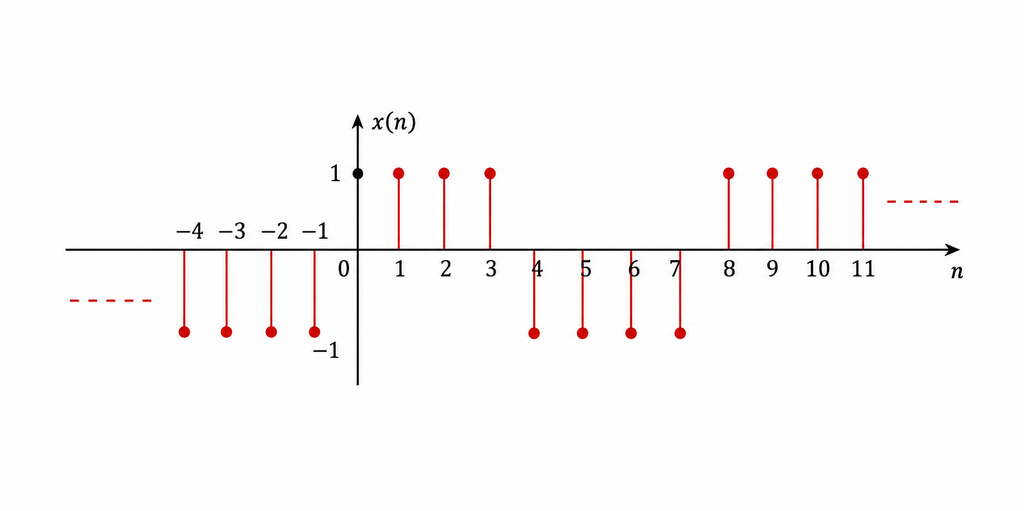
Q2. What is the fundamental frequency of the discrete-time square wave shown below?
Sol:
Above DT-signal starts at n = 0 and again starts at N = 8.
∴ Fundamental period, N = 8 − 0
= 8 samples
Fundamental frequency, f = 1/N = 1/8 Hz
Fundamental frequency in Radians, ω = 2πf = 2π/N
⇒ 2π × 1/N = 2π/N = 2π/8 = π/4 radians
Q3.
Determine whether the continuous-time signal
x(t) = [cos(2πt)]2
is periodic or not?
If periodic, find the fundamental period T.
Sol:
x(t) = [cos(2πt)]2
= cos2(2πt)
= (1 + cos(2 × 2πt)) / 2
= 1/2 + 1/2 cos(4πt)
The first term is constant, so its frequency is zero.
The second term is a cosine signal.
Compare this signal with:
A cos(ωt) = A cos(2πft)
Therefore,
2πft = 4πt
∴ f = 4/2 = 2 Hz
Therefore, the fundamental frequency of the signal is 2 Hz .
Hence, the fundamental period is:
T = 1/f
= 1/2
= 0.5 sec
Use formula:
cos2x = (1 + cos 2x) / 2
Checking periodicity condition: If given signal is periodic, then the condition x(t) = x(t + T) must be satisfied.
Now signal x(t + T) = x(t + 0.5), as follows:
x(t) = [cos(2πt)]2
x(t + 0.5) = [cos 2π(t + 0.5)]2
= cos2{2π(t + 0.5)}
= [1 + cos{4π(t + 0.5)}] / 2
= 1/2 + 1/2 cos(4πt + 2π)
= 1/2 + 1/2 [cos(4πt)cos(2π) − sin(4πt)sin(2π)]
= 1/2 + 1/2 [cos(4πt)×1 − sin(4πt)×0]
= 1/2 + 1/2 cos(4πt)
= (1 + cos(4πt))/2
= cos2(2πt)
= [cos(2πt)]2 = x(t)
Use formula:
cos2x = (1 + cos 2x) / 2
sin nπ = 0
cos 2π = 1
sin 2π = 0
cos(A + B) = cos A cos B − sin A sin B
So, we proved that x(t + 0.5) = x(t).
Hence the given signal is periodic with fundamental period
T = 0.5 seconds
Q4.
Determine whether the following DT-signals are periodic or not?
If periodic, determine the fundamental period N.
(i) cos(0.01πn)
Sol:
cos ωn = cos 2πfn
Compare cos(0.01πn) with cos 2πfn.
∴ 2πfn = 0.01πn
⇒ f = 0.01π / 2π
= 0.01 / 2
= 1/200
= K/N
For periodicity, value of K and N must be integers.
Here K = 1, N = 200.
So, given signal is periodic with period N = 200.
(ii) cos(3πn)
Sol:
cos 2πfn
Compare cos(3πn) with cos 2πfn.
∴ 2πfn = 3πn
⇒ f = 3/2
= K/N
So, f is a rational i.e., ratio of two integers.
Hence the given signal is periodic.
Fundamental period, N = 2.
(iii) sin(πn + 0.2n)
Sol:
Compare sin(πn + 0.2n) with sin(2πfn + φ),
where φ = phase of the signal.
∴ 2πfn + φ = 0.2n + π
Phase = π.
For sine phase, it is not required to check periodic condition.
∴ 2πfn = 0.2n
⇒ f = 0.2 / 2π
f is not ratio of two integers.
So, given signal is not periodic.
Q5.
Check for periodicity of DT signals:
(i) cos(2πn/5) + cos(2πn/7)
(ii) cos(n/8) cos(nπ/8)
Sol:
(i) cos(2πn/5) + cos(2πn/7) is addition of 2 DT-signals.
Find period of each signal separately.
Let x1(n) = cos(2πn/5) & x2(n) = cos(2πn/7)
2πf1n = 2πn/5
∴ f1 = 2/5 = K1/N1
Fundamental period N1 = 5
For the second signal:
2πf2n = 2πn/7
∴ f2 = 2/7 = K2/N2
Fundamental period N2 = 7
Now find N1/N2:
N1/N2 = 5/7
Since 5/7 is a ratio of two integers, hence the given signal is PERIODIC .
Period of composite signal cos(2πn/5) + cos(2πn/7) is calculated as:
LCM(N1, N2) = LCM(5, 7)
= 35
∴ N = 35
(ii) Given signal cos(n/8) · cos(nπ/8) is product of two signals.
Let x1(n) = n/8 & x2(n) = nπ/8
∴ 2πf1n = n/8
∴ f1 = 1/(16π) = K1/N1
f1 is NOT RATIONAL
∴ x1(n) ⇒ NON-PERIODIC
2πf2n = nπ/8
∴ f2 = 1/16 = K2/N2
f2 is RATIONAL
∴ x2(n) is periodic
NOTE:
Product of periodic signal and non-periodic signal is NON-PERIODIC.
Hence, given signal cos(n/8) · cos(nπ/8) is non-periodic.
HOMEWORK ON PERIODIC & NON-PERIODIC SIGNALS
Q.
Check periodicity for following signals. Also find periodicity.
(i) x(t) = 2 cos(3t + π/4)
(ii) x(t) = cos(t + π/4)
(iii) x(t) = cos(πt/3) + sin(πt/4)t
(iv) x(t) = cos t + sin(√2 t)
(v) x(t) = [sin(t – π/4)]2
(i) x(n) cos(3πn)
(ii) x(n) = cos(8πn/7 + 2)
(iii) x(n) = cos(πn/3) · sin(2n)
(iv) cos 2πn
(v) sin(π + 0.2n)
(vi) ej(π/4)n
NOTE:
Addition of more than 2 periodic signals can be analysed for periodicity by finding the ratio of the period of any one signal with the period of each of the others.
If any ratio is not a rational number, the composite signal can’t be periodic.
If periodic, the period of the composite signal can be obtained from the LCM of the denominators of all the ratios.
