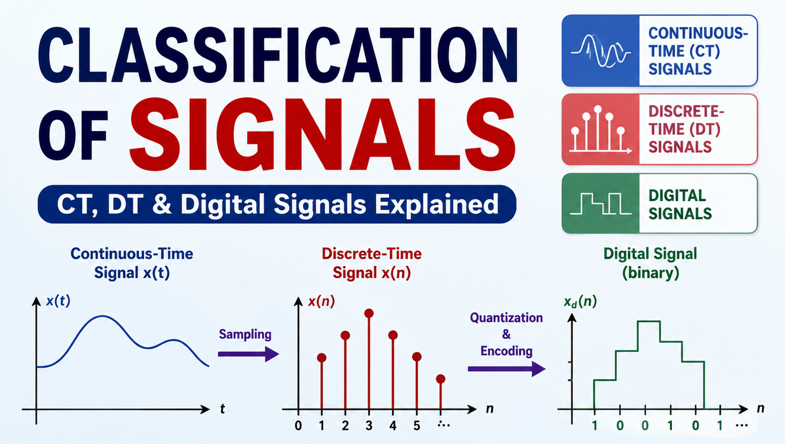
Classification of Signals | Signals & Systems
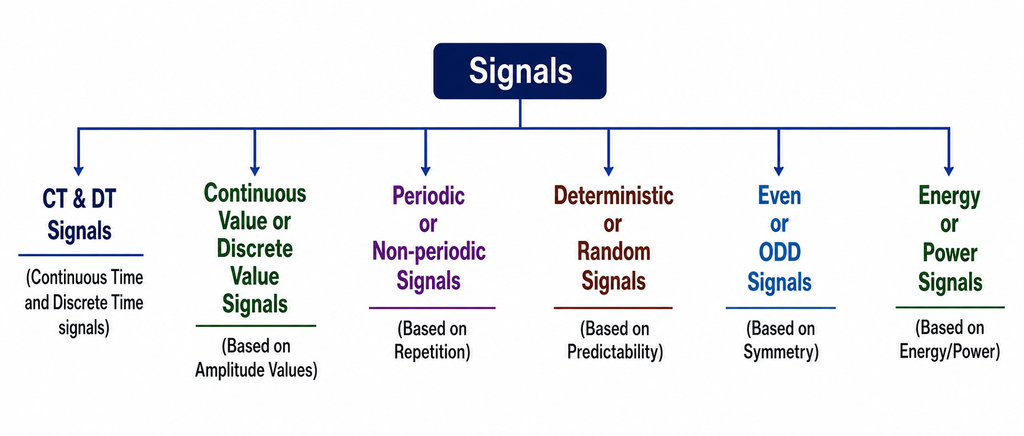
Based on their nature and characteristics, signals may be broadly classified as:
- Continuous-Time (CT) Signals – also known as Analog Signals
- Discrete-Time (DT) Signals
- Digital Signals
Note: A discrete-time (DT) signal is obtained from a continuous-time (CT) signal through a process called SAMPLING. Digital signals are obtained from discrete-time signals by applying further processes called QUANTIZATION and Analog-to-Digital Conversion (ADC).
Further Classification of Signals
Note that we can further classify both CT and DT signals as follows:
(i) Deterministic & Non-deterministic Signals — Random Signals
(ii) Periodic & Non-periodic Signals — Aperiodic Signals
(iii) Even and Odd Signals
(iv) Energy and Power Signals
Continuous Signal
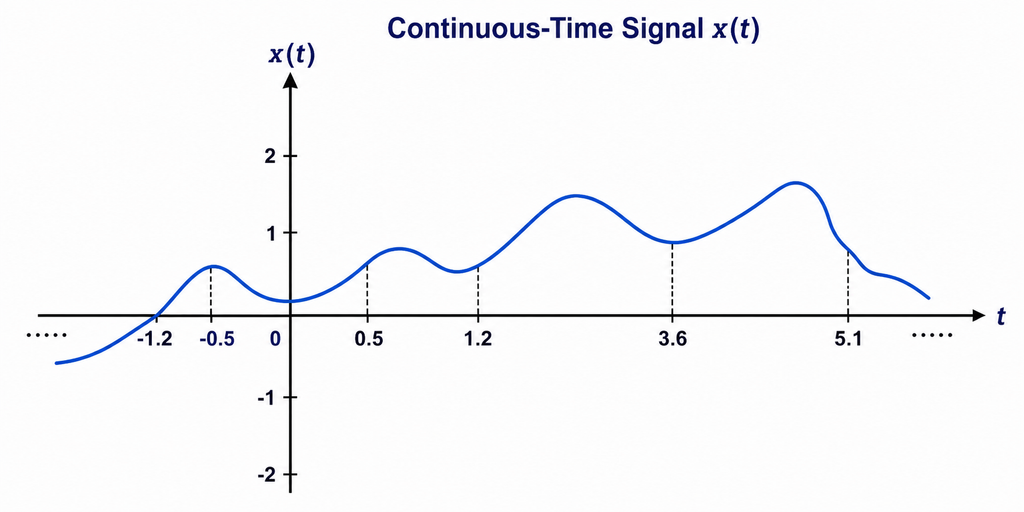
Continuous Signal: A signal which varies continuously with time is called a continuous-time (CT) signal. Note that a CT signal has to be defined for all values of .
The signal shown here is continuous in time and continuous in amplitude.
A continuous-time signal is represented by , where represents the shape of the signal and is an independent variable.
The signal will have some value at every point of time .
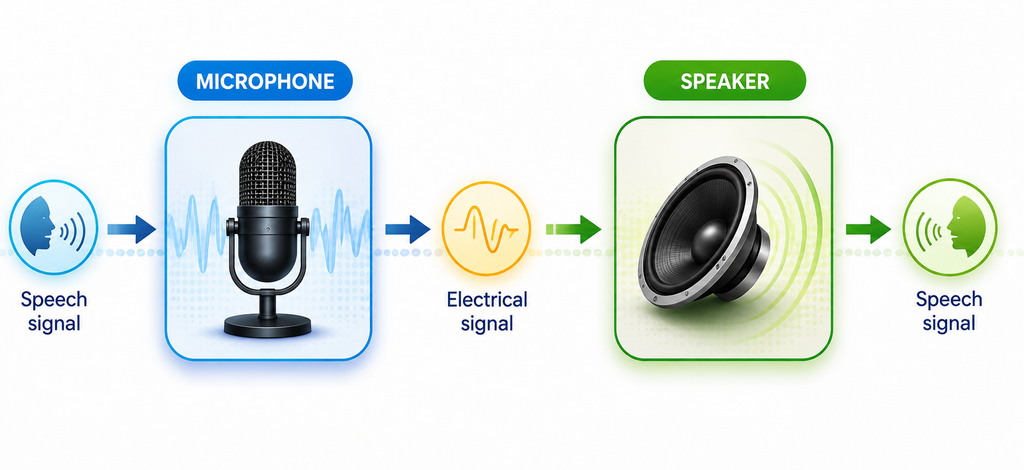
CT signals arise naturally, when a physical phenomenon (speech, heart-beat, earth-quake etc.) is converted into an electrical signal using appropriate TRANSDUCER. Transducer is an electronic device, which converts one form of energy to other form. Some examples of transducer are: Microphone & Speaker.

Discrete-Time Signal
DISCRETE-TIME SIGNAL: A DT signal can be obtained from a CT signal by sampling. A DT signal is defined only at certain time instants. Note that for a DT signal, the amplitude between two time instants is not defined.
A DT signal is represented by . Here, represents the independent variable (time).
Note that for a DT signal, is an integer. n=0, ±1, ±2, ±3, …, ±∞
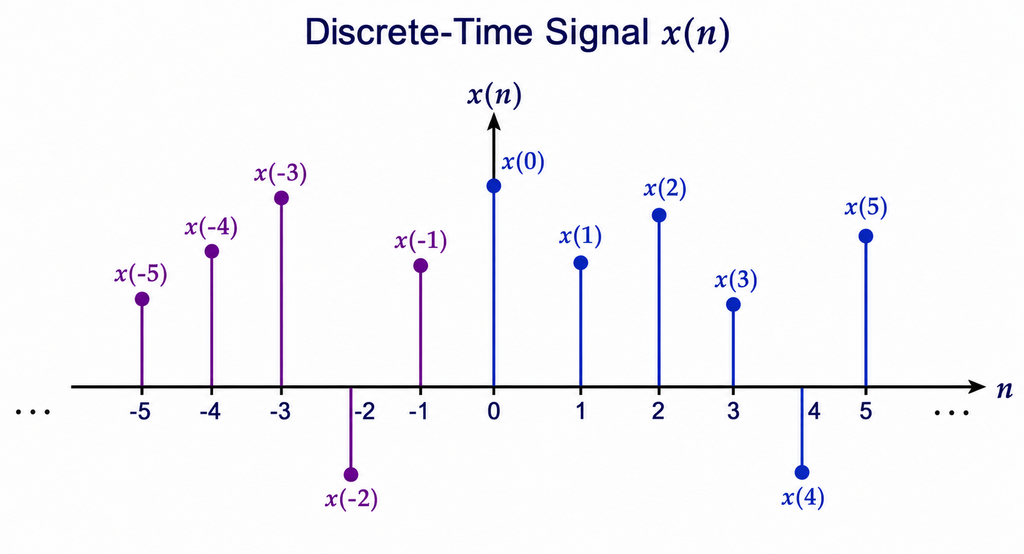
Practically, a DT signal is obtained from CT signal using sampling process. Samples are taken at regular time intervals; this regular time-interval is known as sampling time TT. Samples are nothing but amplitude values.
A DT signal is a sequence of samples obtained from a CT signal as shown below.
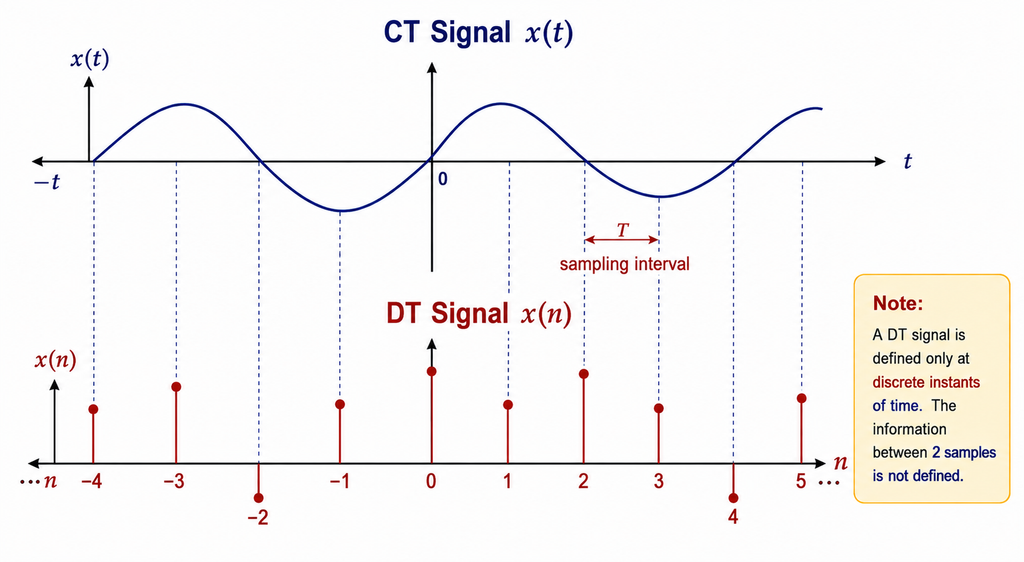
Note: If we take blood pressure readings of a patient after every 1 hour and plot the graph, then the resultant signal will be a discrete-time (DT) signal.
So, from the generation point of view, signals can be:
Generation Point of View
-
Naturally generated signals
Example: Speech, heart-beat, etc. -
Synthetically generated signals
Example: Discrete signals
Note: All naturally occurring signals are analog in nature.
Analog signals are also known as continuous signals.
Signals in a computing environment are digital. A digital signal is composed of binary numbers 1 and 0.
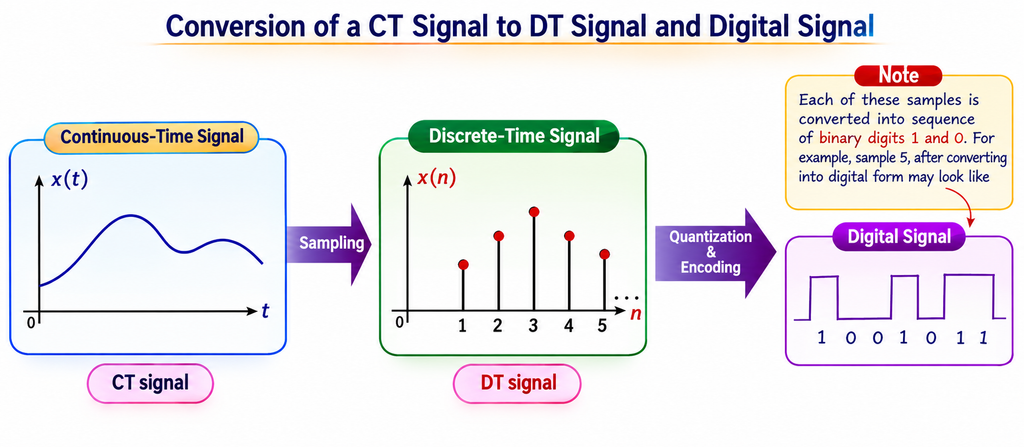
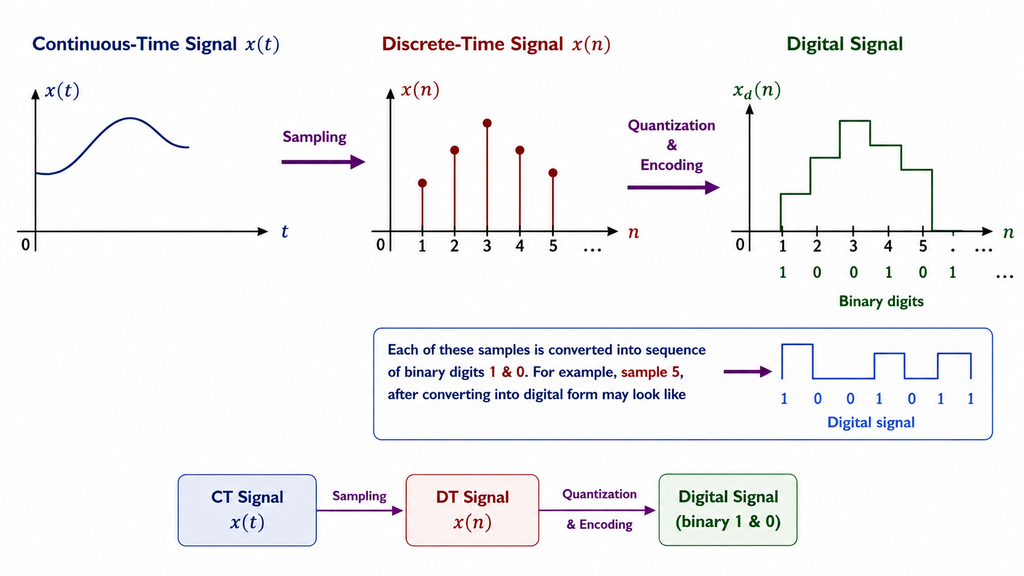
In the above figure, first the continuous-time signal is converted into a discrete-time signal . Next, each sample is converted to a digital signal.
In telephonic communication, while processing the voice signal, intermediate signals generated are discrete and digital signals. So, discrete and digital signals are synthetically generated signals. And the processing of these signals is called computing environment.
Note: The electrical signals derived in proportion with the physical quantities such as sound, temperature, pressure, etc. are continuous signals. The other examples of continuous signals are: sine wave, cosine wave, triangular wave, etc.
