Python Built-in Classes – Simple Guide for Beginners
Python provides many built-in classes that make programming simple and powerful. You can use these classes directly without defining them yourself.
If you are coming from C, C++, or Java, you may already know concepts such as int, float, char, arrays, and classes. Python uses some similar concepts, but its object model is different.
In Python, commonly used data types such as integers, floating-point numbers, strings, lists, and dictionaries are represented by built-in classes.
What Is a Built-in Class in Python?
A built-in class is a class that Python provides for us.
We do not have to define these classes before using them.
For example:
x = 10Here:
intis a built-in Python class.10is an object (instance) of theintclass.xis a name that refers to that object.
We can check the type of x using:
print(type(x))Output:
<class 'int'>So, in simple terms:
int → built-in class10 → object of the int classx → name referring to the object
Built-in Classes vs Data Types
In languages such as C, you may write:
int x = 10;Here, int is a built-in data type and x is an integer variable.
In Python, we write:
x = 10Python does not require us to declare the type of x separately.
The object 10 has type int, and the name x refers to that object.
This is one of the important differences between Python and languages such as C, C++, and Java.
Common Built-in Classes in Python
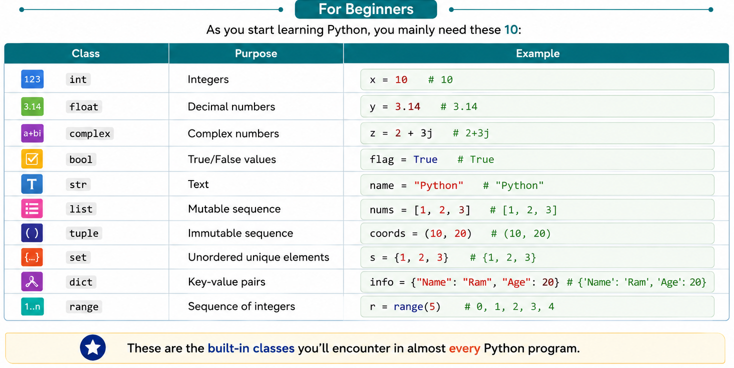
Python has many built-in classes. As a beginner, you will frequently work with the following ones:
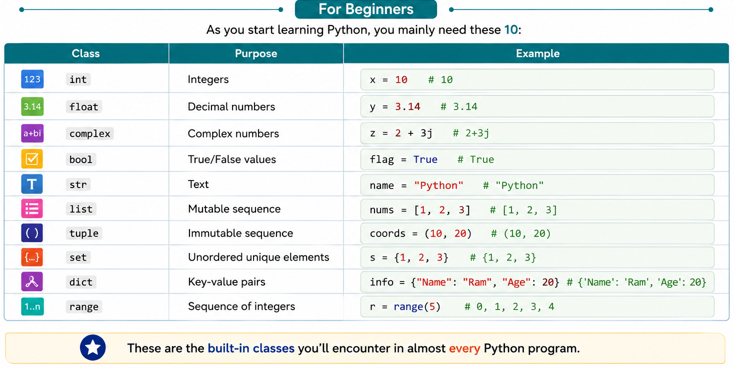
| Built-in class | Used for | Example |
| int | Integers | 10 |
| float | Decimal numbers | 3.14 |
| complex | Complex numbers | 2+3j |
| bool | True/False values | True |
| str | Text | “Python” |
| list | Ordered, changeable collection | [10, 20, 30] |
| tuple | Ordered, unchangeable collection | (10, 20, 30) |
| set | Unique elements | {10, 20, 30} |
| dict | Key-value pairs | {“name”: “Ram”} |
| range | Sequence of integers | range(5) |
A Simple Comparison with C, C++ and Java
If you have learned C, C++, or Java, the following comparison can help.
C
You might write:
int x = 10;
float price = 3.14;
Here, int and float are built-in data types.
Python
You write:
x = 10
price = 3.14
Python automatically associates the objects with their types.
10       → int object
3.14     → float object
"Hello"  → str object
[1, 2]   → list object
In Python, you don’t normally declare a variable’s type before assigning a value.
Python’s Object-Oriented Approach
This is one of the interesting features of Python.
Consider:
x = 10The number 10 is an object of the int class.
Similarly:
name = "Python""Python" is an object of the str class.
And:
numbers = [10, 20, 30]The list is an object of the list class.
So we can think of Python like this:
Built-in Class       Example Object

int       ─────────→  10
float     ─────────→  3.14
str       ─────────→  "Python"
list      ─────────→  [10, 20, 30]
tuple     ─────────→  (10, 20, 30)
set       ─────────→  {10, 20, 30}
dict      ─────────→  {"name": "Ram"}
This object-based approach is one reason Python is easy to extend with your own classes.
Quick Revision
Remember these important points:
- Python provides many built-in classes.
intrepresents integer numbers.floatrepresents decimal numbers.complexrepresents complex numbers.boolrepresentsTrueandFalse.strrepresents text.listrepresents an ordered, changeable collection.tuplerepresents an ordered, unchangeable collection.setrepresents a collection of unique elements.dictrepresents key-value pairs.rangerepresents a sequence of integers.- Values created from these classes are objects.
- Python does not normally require you to declare a variable’s type before assigning a value.
Final Thought
If you are coming from C, C++, or Java, it may take a little time to become comfortable with Python’s object model.
A simple way to remember it is:
In Python, classes define objects, and names are used to refer to those objects.
Once you understand this idea, many other Python concepts—including lists, strings, functions, classes, and object-oriented programming—become much easier to understand.