Periodic and Non-Periodic Signals | Course: Signals & Systems
Periodic Signal
Periodic Signal:
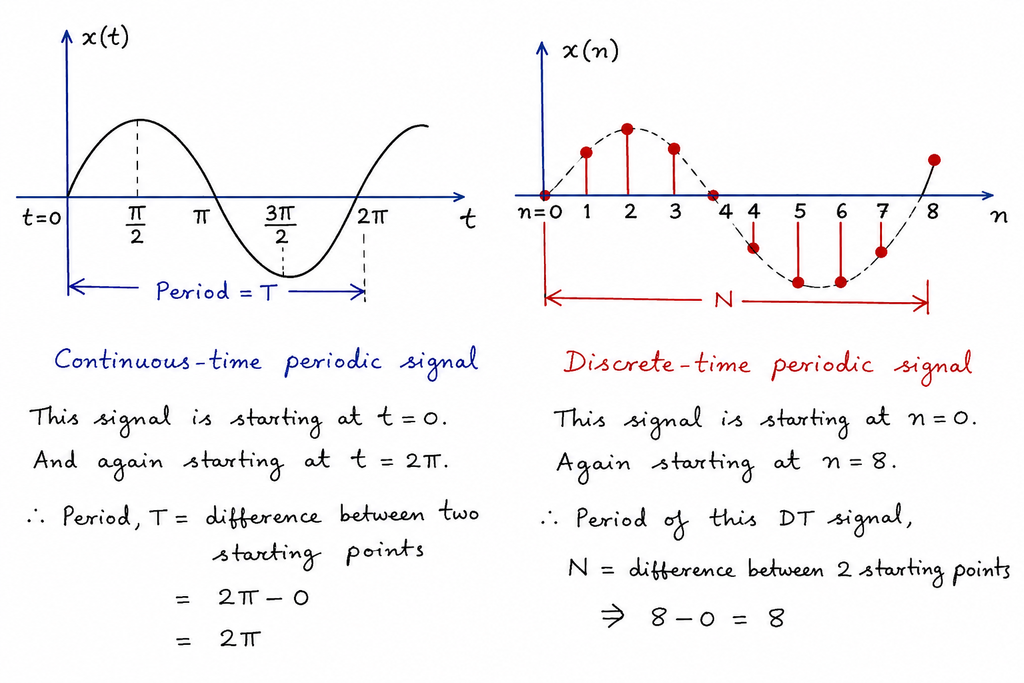
A signal which repeats itself after a fixed time period is called a periodic signal.
Condition of Periodicity
A signal is periodic if:
where,
- = Time period of
The smallest positive value of TT for which the above condition is satisfied is called the fundamental time period of the signal.
Examples of Periodic Signals
Some common examples of periodic signals are:
- Sine Wave
- Square Wave
- Cosine Wave
- Triangular Wave
- Sawtooth Wave
Classification of Periodic Signals
Periodic signals can be classified into two types:
Periodic Signals
1. Continuous-Time
Periodic Signal
2. Discrete-Time
Periodic Signal
Periodic DT Signal
Periodic DT Signal: Condition of periodicity is given as:
where N = period of the signal.
Non-periodic Signal
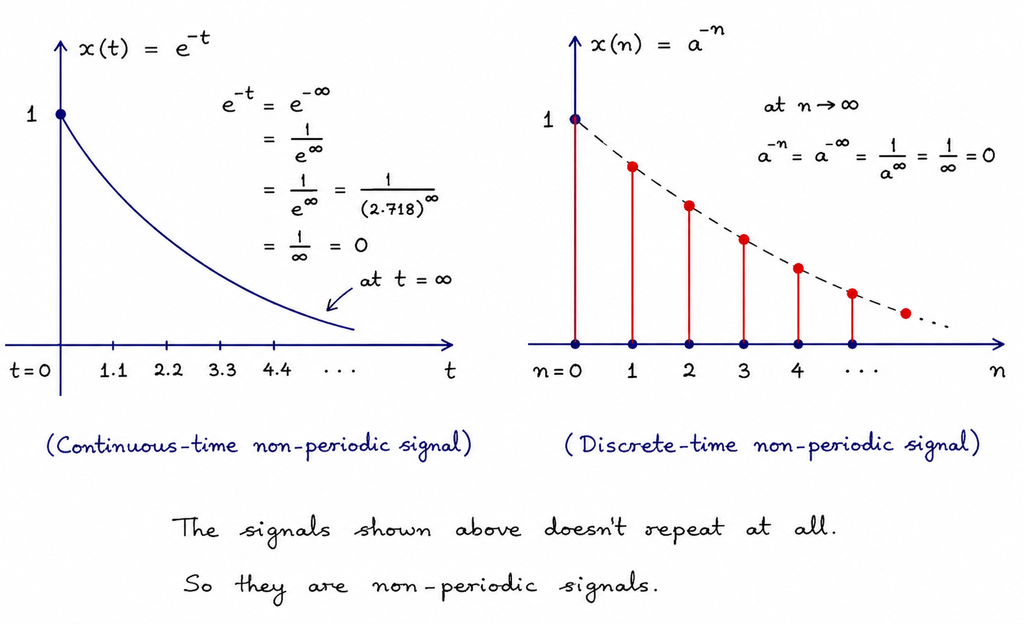
Non-periodic signal: A non-periodic signal is also known as an aperiodic signal. A non-periodic signal doesn’t satisfy the condition:
So, for a non-periodic signal,
x(t) ≠ x(t + T)
Non-periodic Signal
A non-periodic signal can be classified into two types:
- Continuous-time non-periodic signal
- Discrete-time non-periodic signal
Discrete Non-periodic Signal
Discrete non-periodic signal:
Condition:
x(n) ≠ x(n + N)
where:
- = DT signal
- = integer
- = discrete-time variable
- = period of DT signal