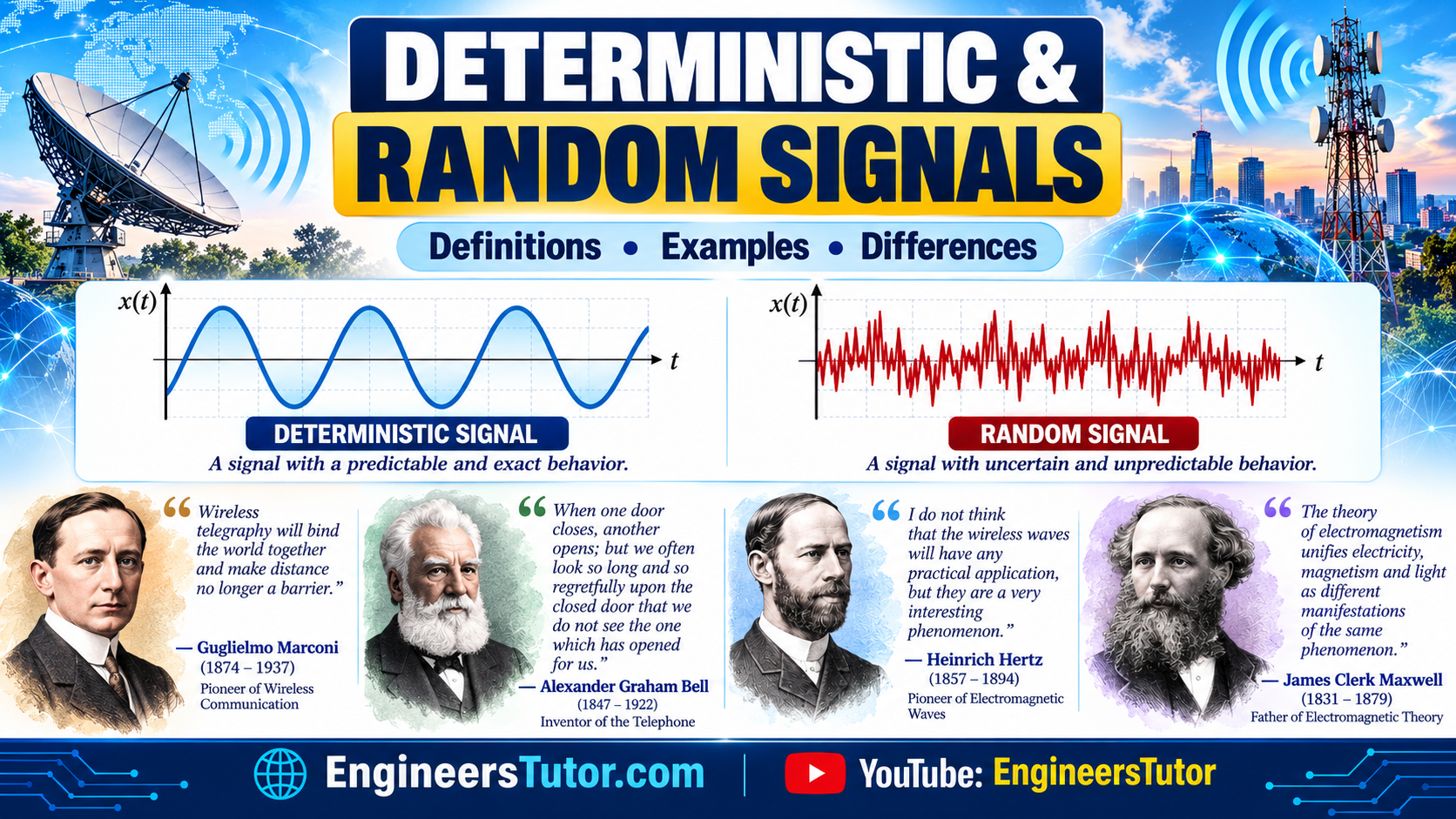
Deterministic and Random Signals – Definition, Examples & Differences
Deterministic & Random Signals
Deterministic Signal:
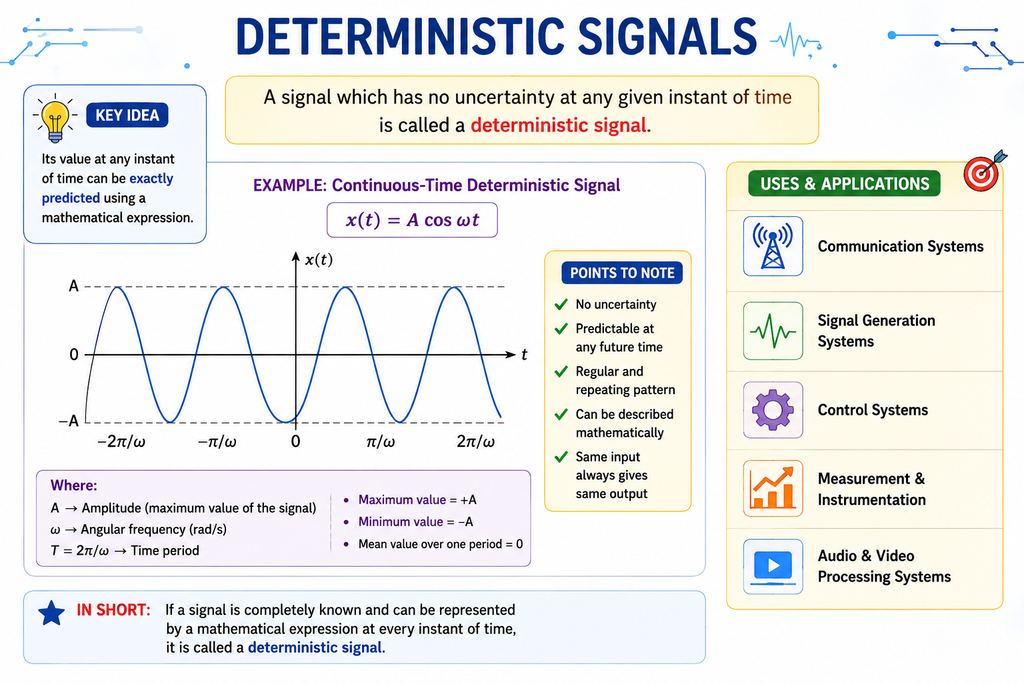
A signal which has no uncertainty at any given instant of time is called a deterministic signal.
Ex:
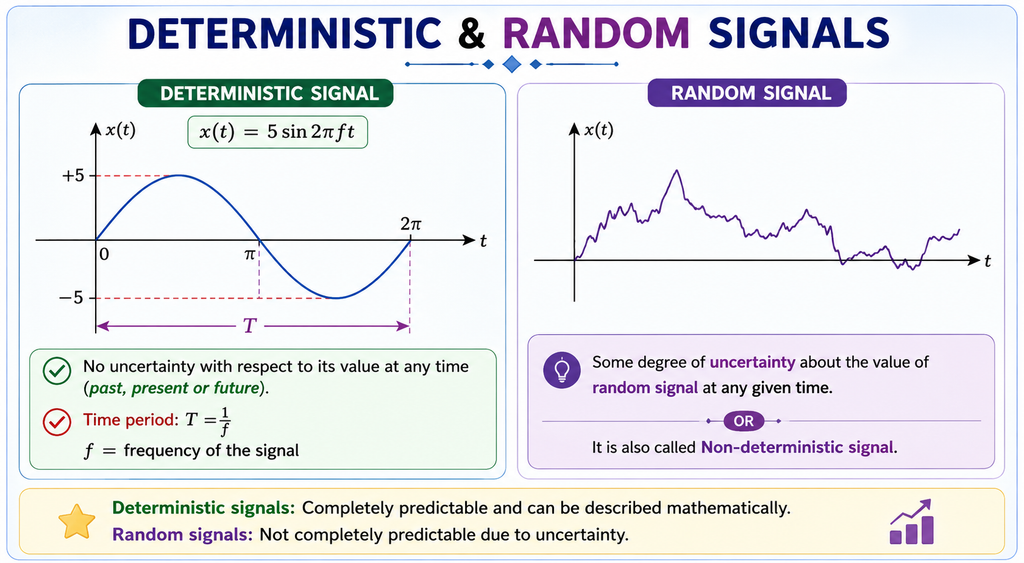
At any given time, the behaviour of the signal can be predicted. So, for a deterministic signal, the amplitude value of can be computed. The pattern of deterministic signal is regular and can be characterised mathematically (i.e. can be put in an equation).
Non-Deterministic Signal (Random Signal)
A non-deterministic signal is a signal whose behaviour cannot be predicted in advance. The pattern of a random signal is quite irregular. Random signals are also known as non-deterministic signals.
Examples of Random Signals
- Noise generated in the amplifier of a radio receiver.
- ECG signal (heart-beat signal).
- Speech signal.
- Weather noise and atmospheric noise.
Important Points to Note
- The value of a random signal cannot be predicted at any given instant of time.
- It contains some degree of uncertainty.
- Its behaviour is irregular and cannot be represented by a single mathematical equation.
- Random signals are analysed using statistical methods rather than exact mathematical expressions.
Difference Between Deterministic and Random Signals
| Deterministic Signal | Random Signal |
|---|---|
| Its value can be predicted exactly at any given time. | Its value cannot be predicted exactly at any given time. |
| There is no uncertainty about its behaviour. | There is some uncertainty about its behaviour. |
| Usually follows a known and regular pattern. | Usually has an irregular or unpredictable pattern. |
| Can be described using a mathematical equation. | Is generally described using probability and statistical properties. |
| Example: x(t) = A cos(ωt) | Examples: noise, speech signal, and ECG signal. |
| Also called a predictable signal. | Also called a non-deterministic signal. |
