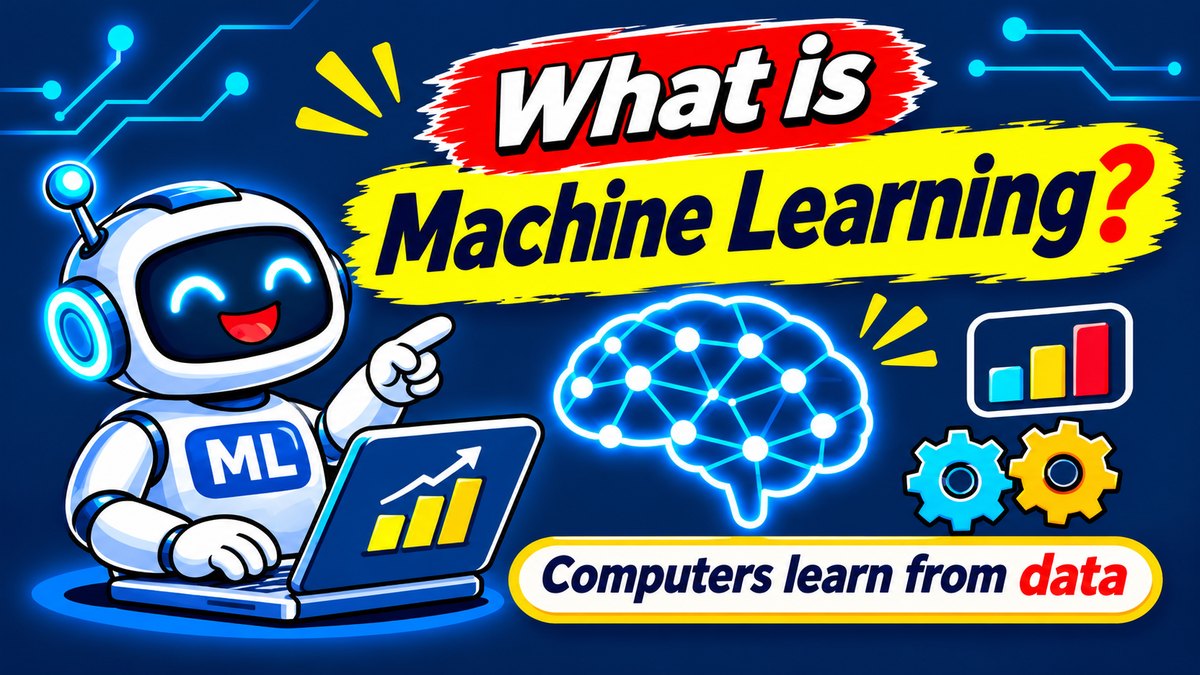
What is Machine Learning?
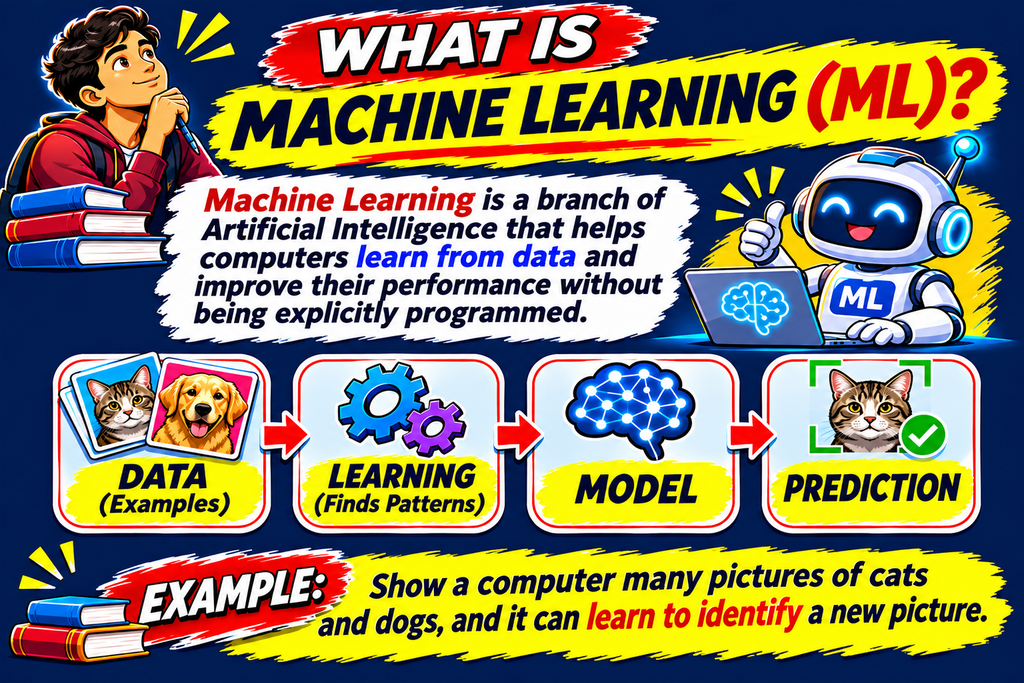
💡 What is Machine Learning (ML)?
Machine Learning (ML) is a branch of Artificial Intelligence (AI) that enables computers to learn from data and improve their performance without being explicitly programmed for every task. In simple words, computers study examples, identify patterns and use what they have learned to make predictions or decisions.
🐱 Simple Example: If we show a computer many pictures of cats and dogs, it can learn to recognize their patterns and identify whether a new picture contains a cat or a dog.
🚀 Machine Learning helps computers learn from experience!
What is a Pattern in AI & ML?
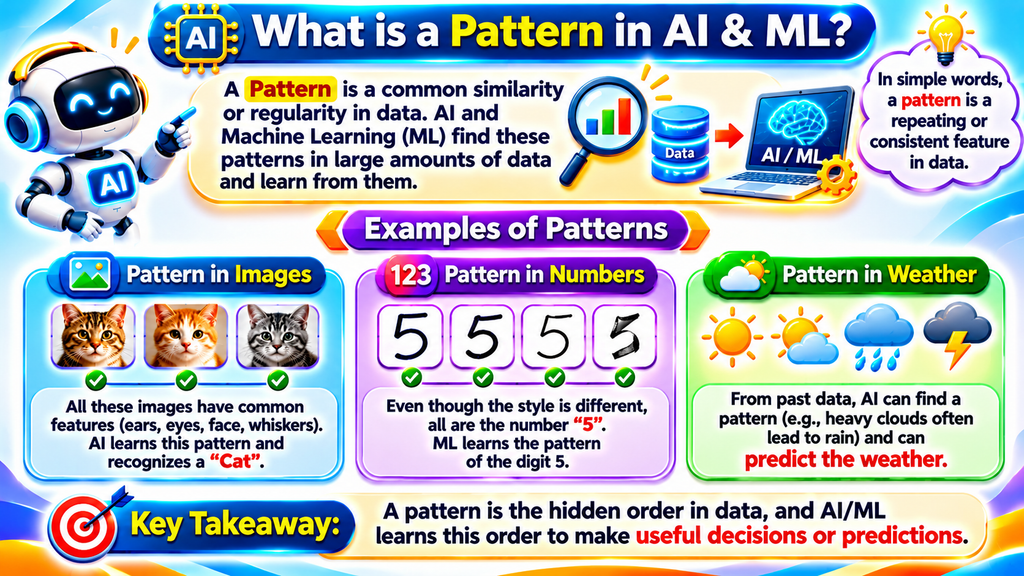
🔍 What is a Pattern in AI & ML?
A pattern is a common similarity or something that repeats in data. Artificial Intelligence (AI) and Machine Learning (ML) identify these common features by analyzing large amounts of information. In simple words, a pattern helps a computer understand what is common among different pieces of data.
💡 Three Simple Examples:
🐱 Images: Different cat pictures share common features such as ears, eyes, whiskers and a face. AI can learn these features to recognize a cat in a new picture.
🔢 Numbers: The handwritten number 5 may look different when written by different people, but it still has common features. ML can learn these features to recognize the number 5.
🌧️ Weather: By studying past weather data, AI can identify relationships between weather conditions and rainfall, helping to predict the weather.
🎯 Remember: A pattern is something common or repeated in data. AI and ML learn these patterns to recognize things, make decisions and produce predictions.
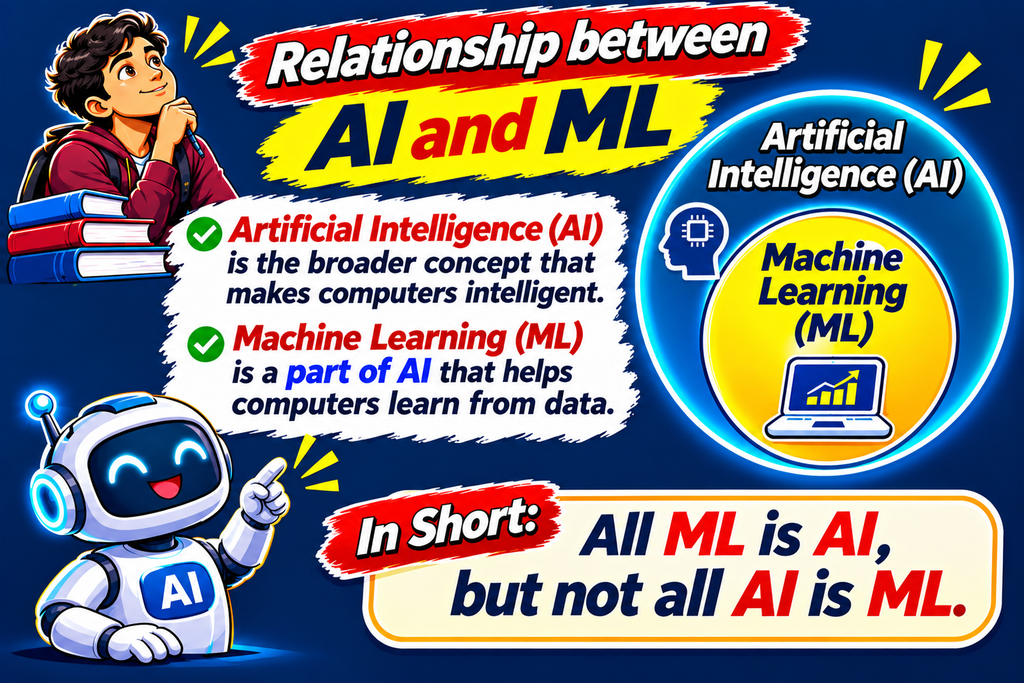
🤖 Relationship Between AI and ML
Artificial Intelligence (AI) is a broad field of technology that aims to make computers perform tasks that normally require human intelligence, such as learning, problem-solving and decision-making. Machine Learning (ML) is a part of AI that enables computers to learn from data and identify patterns to make predictions or decisions.
💡 Remember: AI is the bigger concept, while ML is one of the ways to achieve AI. Therefore, all Machine Learning is AI, but not all AI is Machine Learning.
🎯 AI is the bigger picture; ML is a part of it!
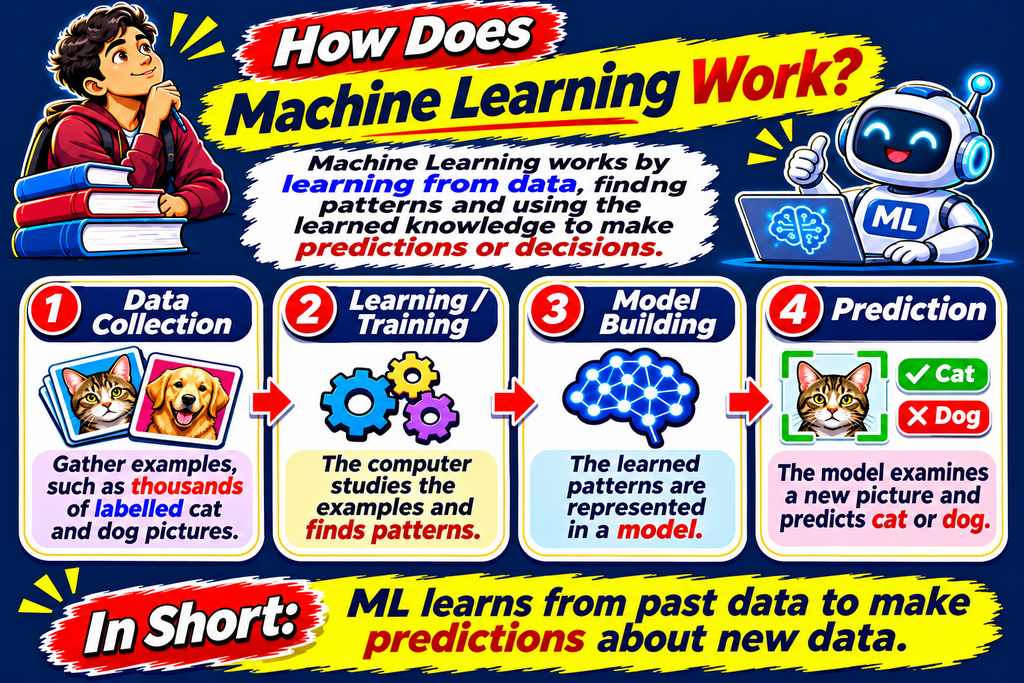
⚙️ How Does Machine Learning Work?
Machine Learning works by learning from data. First, computers are trained using thousands of examples, such as pictures, numbers or text. During this training process, they study the data, identify patterns and learn useful information. This knowledge is used to build a Machine Learning Model, which can make predictions or decisions when it receives new data.
🐱 Simple Example: Suppose we want a computer to identify cats and dogs. We provide thousands of labelled cat and dog images for training. The computer learns their patterns and features. After training, it can examine a new picture and predict whether it contains a cat or a dog.
🚀 Remember the process:
📂 Data → 🧠 Training → ⚙️ Model → 🎯 Prediction
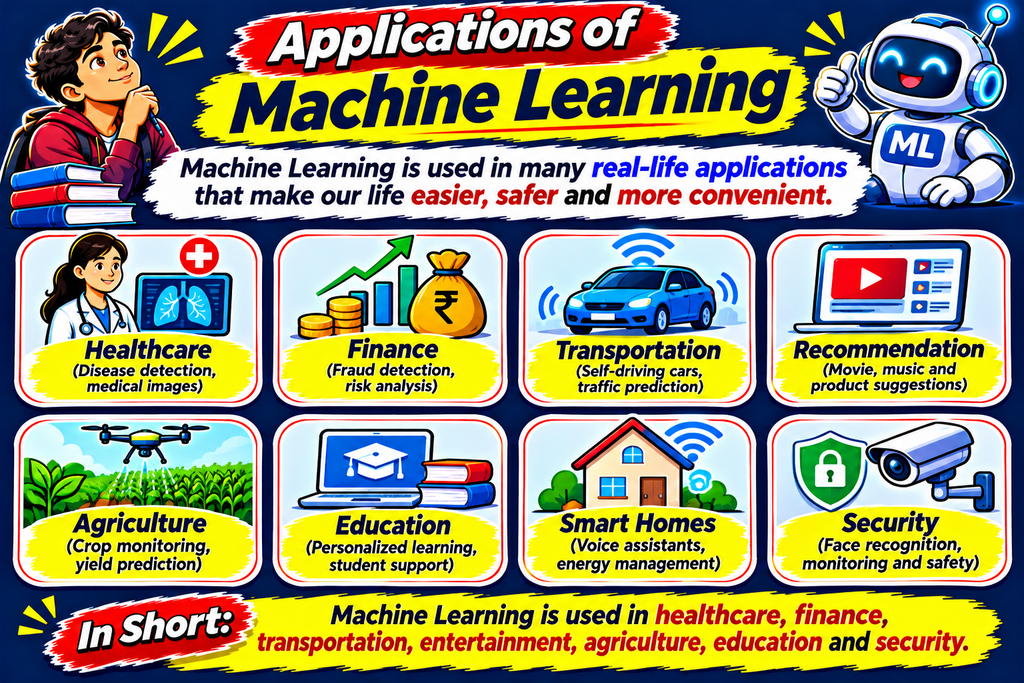
🌍 Applications of Machine Learning
Machine Learning (ML) is used in many areas of our daily lives. It helps computers analyse data, identify patterns and make useful predictions. From healthcare to entertainment, ML makes many tasks easier, faster and smarter.
🏥 1. Healthcare: Helps doctors detect diseases and analyse medical images.
💰 2. Finance: Helps detect fraudulent transactions and analyse financial risks.
🚗 3. Transportation: Supports self-driving cars and traffic prediction.
▶️ 4. Recommendations: Suggests movies, music and products based on user interests.
🌱 5. Agriculture: Helps monitor crops and predict agricultural yields.
🎓 6. Education: Supports personalized learning and student performance analysis.
🏠 7. Smart Homes: Powers voice assistants and helps manage energy usage.
🔒 8. Security: Supports face recognition, surveillance and safety monitoring.
🚀 In Short: Machine Learning is transforming many industries by helping computers learn from data and perform tasks more intelligently.
⚖️ Advantages and Limitations of Machine Learning
Machine Learning offers many benefits, but it also has some limitations. Let’s understand both sides.
✅ Advantages of Machine Learning
⚡ Automation: Performs repetitive tasks automatically and saves time.
🎯 Better Predictions: Identifies patterns in data to make useful predictions.
📊 Handles Large Data: Analyses large amounts of information quickly.
🧠 Continuous Improvement: Models can improve their performance when trained with suitable additional data and updated appropriately.
⚠️ Limitations of Machine Learning
📂 Data Dependency: Requires suitable and sufficient quality data for effective learning.
⚖️ Bias: Biased training data can lead to unfair or inaccurate results.
💻 Cost: Training complex models may require powerful computers, time and resources.
❌ Errors: Predictions are not always correct, and models may fail with unfamiliar data.
💡 Remember: Machine Learning is powerful, but it is not perfect!