What is Artificial Intelligence?
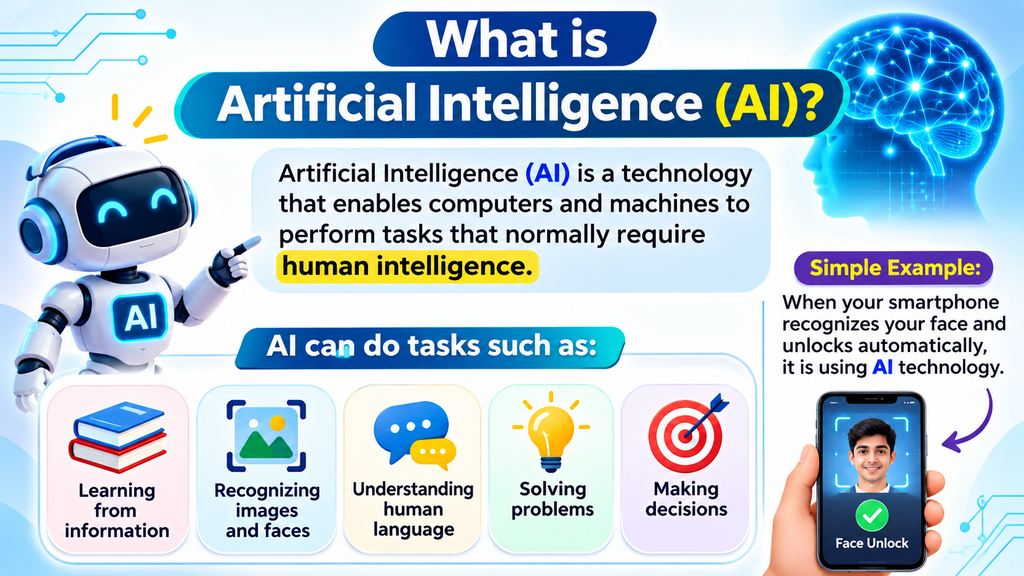
🤖 What is Artificial Intelligence (AI)?
Artificial Intelligence (AI) is a technology that enables computers and machines to perform tasks that normally require human intelligence. These tasks include learning from information, recognizing images and faces, understanding human language, solving problems, and making decisions.
💡 Simple Example: When your smartphone recognizes your face and unlocks automatically, it uses Artificial Intelligence (AI) technology.
🧠 AI vs Human Intelligence
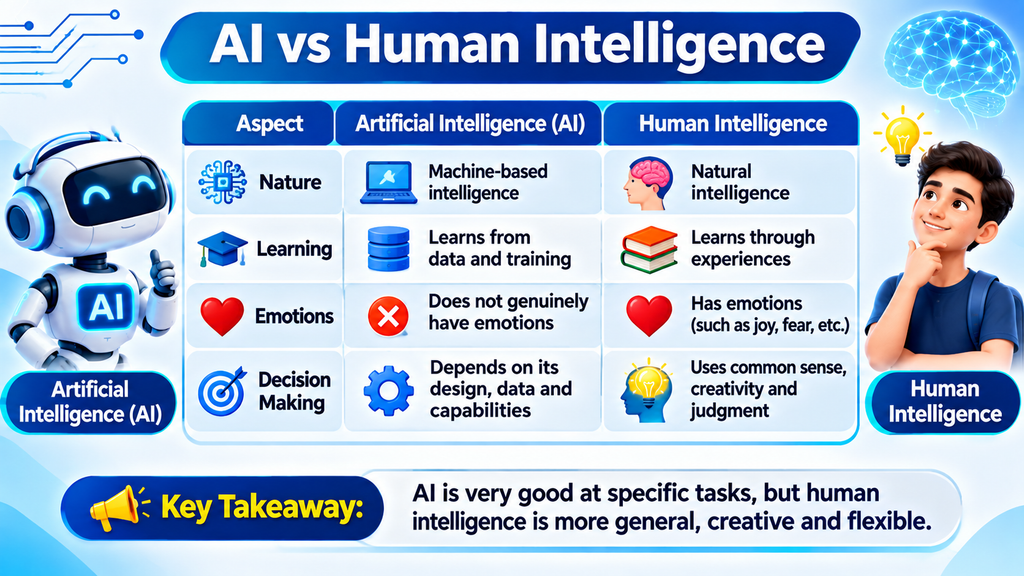
Artificial Intelligence (AI) and human intelligence both help solve problems and perform tasks. However, they work differently. AI uses data, algorithms and training, whereas humans use their natural intelligence, experiences and emotions.
| Aspect | 🤖 AI | 🧑 Human |
|---|---|---|
| Nature | Machine-based intelligence | Natural intelligence |
| Learning | Learns from data and training | Learns through experience |
| Emotions | Does not genuinely feel emotions | Experiences emotions like joy and sadness |
| Decision Making | Uses data, patterns and algorithms | Uses knowledge, judgment and common sense |
💡 Remember: AI is very good at performing specific tasks, but human intelligence is more general, creative and adaptable.
⚙️ How Does Artificial Intelligence Work?
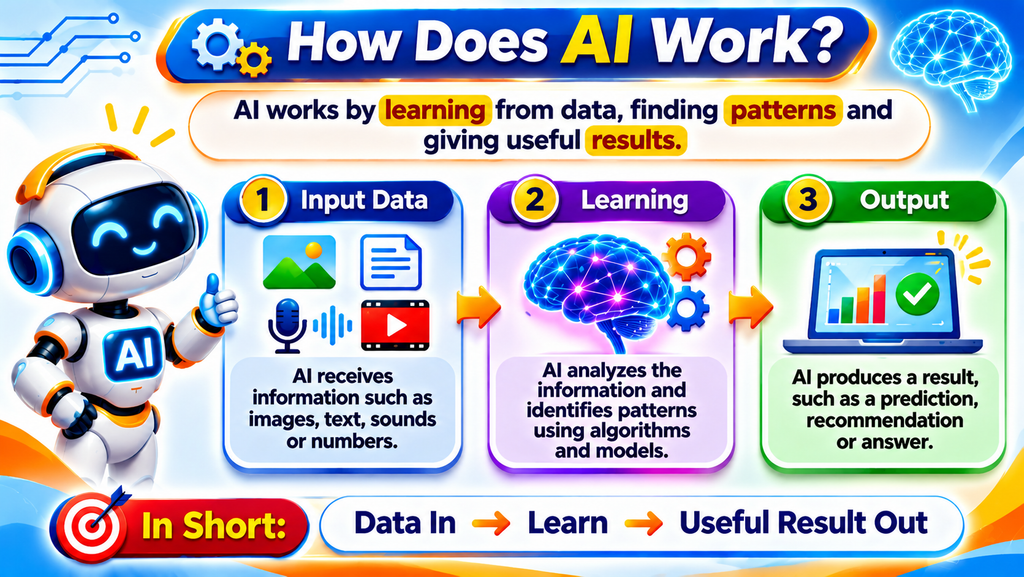
AI works by learning from data, finding patterns and producing useful results. We can understand this process in three simple steps:
1. 📥 Input Data
First, AI receives information such as images, text, sounds or numbers. This information is called data.
2. 🧠 Learning
Next, AI analyzes the information and learns to identify patterns using algorithms and models.
3. 📊 Output
Finally, AI produces a result, such as a prediction, recommendation or answer.
💡 Remember: AI follows a simple process: Data In → Learning → Useful Result Out.
🔍 What is a Pattern in AI & ML?
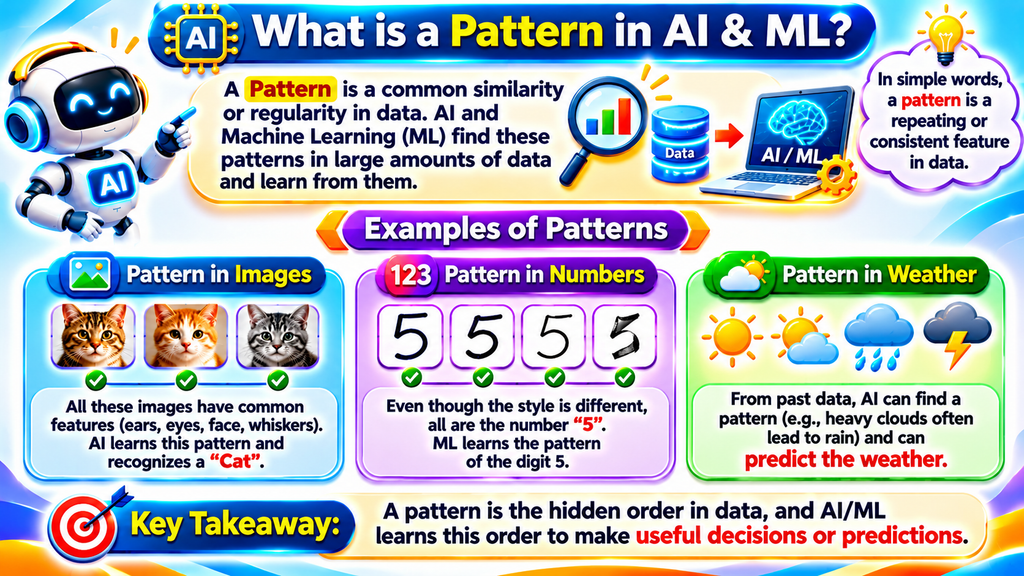
A pattern is a common similarity or something that repeats in data. Artificial Intelligence (AI) and Machine Learning (ML) identify these common features by analyzing large amounts of information. In simple words, a pattern helps a computer understand what is common among different pieces of data.
💡 Three Simple Examples:
🐱 Images: Different cat pictures share common features such as ears, eyes, whiskers and a face. AI can learn these features to recognize a cat in a new picture.
🔢 Numbers: The handwritten number 5 may look different when written by different people, but it still has common features. ML can learn these features to recognize the number 5.
🌧️ Weather: By studying past weather data, AI can identify relationships between weather conditions and rainfall, helping to predict the weather.
🎯 Remember: A pattern is something common or repeated in data. AI and ML learn these patterns to recognize things, make decisions and produce predictions.
🧠 Types of Artificial Intelligence
Artificial Intelligence can be classified into different types based on its abilities. At a basic level, let’s understand two important types: Narrow AI and General AI.
🤖 1. Narrow AI (Weak AI)
Narrow AI is designed to perform a specific task. For example, face recognition identifies faces, voice assistants understand spoken commands, and recommendation systems suggest videos. Most AI systems we use today belong to this category.
🌐 2. General AI (AGI)
General AI is a theoretical form of AI that could learn, understand and perform a wide range of intellectual tasks like a human being. It would be capable of handling different tasks rather than being limited to one specific task. Human-level General AI has not yet been achieved.
💡 Remember: Narrow AI performs specific tasks, whereas General AI aims to perform a wide range of tasks like human intelligence.
🌍 Real-Life Examples of Artificial Intelligence
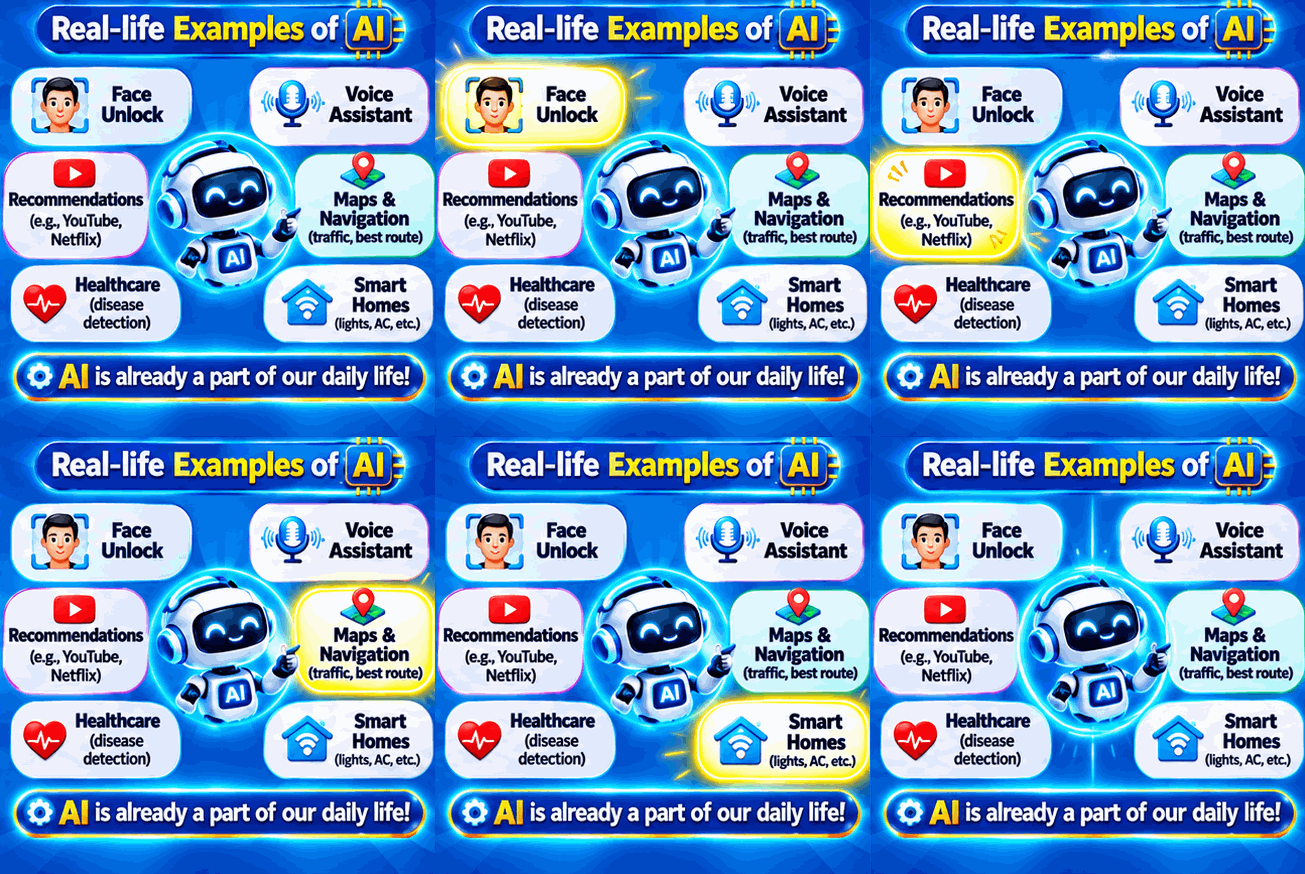
Artificial Intelligence is not just a technology of the future. We already use AI in our everyday lives, often without even realizing it. Here are some common examples:
🎙️ 1. Voice Assistants
Voice assistants understand spoken commands and answer questions. Examples include Siri and Google Assistant.
📱 2. Face Recognition
Smartphones use face recognition technology to identify users and unlock devices.
▶️ 3. Video Recommendations
Platforms like YouTube analyze viewing activity to suggest videos that users may enjoy.
🚗 4. Self-Driving Cars
AI helps self-driving cars detect roads, traffic signals, pedestrians and other vehicles.
❤️ 5. Healthcare
AI can help doctors analyze medical images and identify signs of certain diseases.
🏠 6. Smart Homes
Smart home devices use AI to help control lights, appliances and other connected devices.
💡 Remember: AI is already part of our daily lives, making many activities easier, faster and smarter.
⚖️ Advantages and Limitations of AI
Artificial Intelligence offers many benefits in our daily lives, education, healthcare and industries. However, like every technology, AI also has some limitations. Let’s understand both sides.
✅ Advantages of AI
⚡ Saves Time: AI can complete many tasks quickly.
📊 Analyzes Data: AI can process large amounts of information and identify useful patterns.
🤖 Automates Tasks: AI can perform repetitive tasks with less human effort.
💡 Helps in Decision-Making: AI can provide useful predictions and suggestions.
⚠️ Limitations of AI
❌ Can Make Mistakes: AI may produce incorrect or misleading results.
📚 Depends on Data: Poor-quality or biased data can lead to poor results.
🧠 Lacks Human Understanding: AI does not have human emotions or genuine human experiences.
💰 Can Be Expensive: Developing and running some AI systems requires powerful computers and resources.
💡 Remember: AI is a powerful tool, but it is not perfect. We should use it wisely and always apply human judgment.
🚀 In Conclusion – Artificial Intelligence
Artificial Intelligence (AI) is changing the way we live, learn and work. From smartphones and voice assistants to healthcare and self-driving cars, AI is becoming an important part of our everyday lives. It helps machines learn from data, recognize patterns and perform useful tasks.
💡 Remember: AI is a powerful technology that can help us solve real-world problems and create exciting opportunities for the future.
🌟 Keep Learning, Keep Exploring and Stay Curious!
