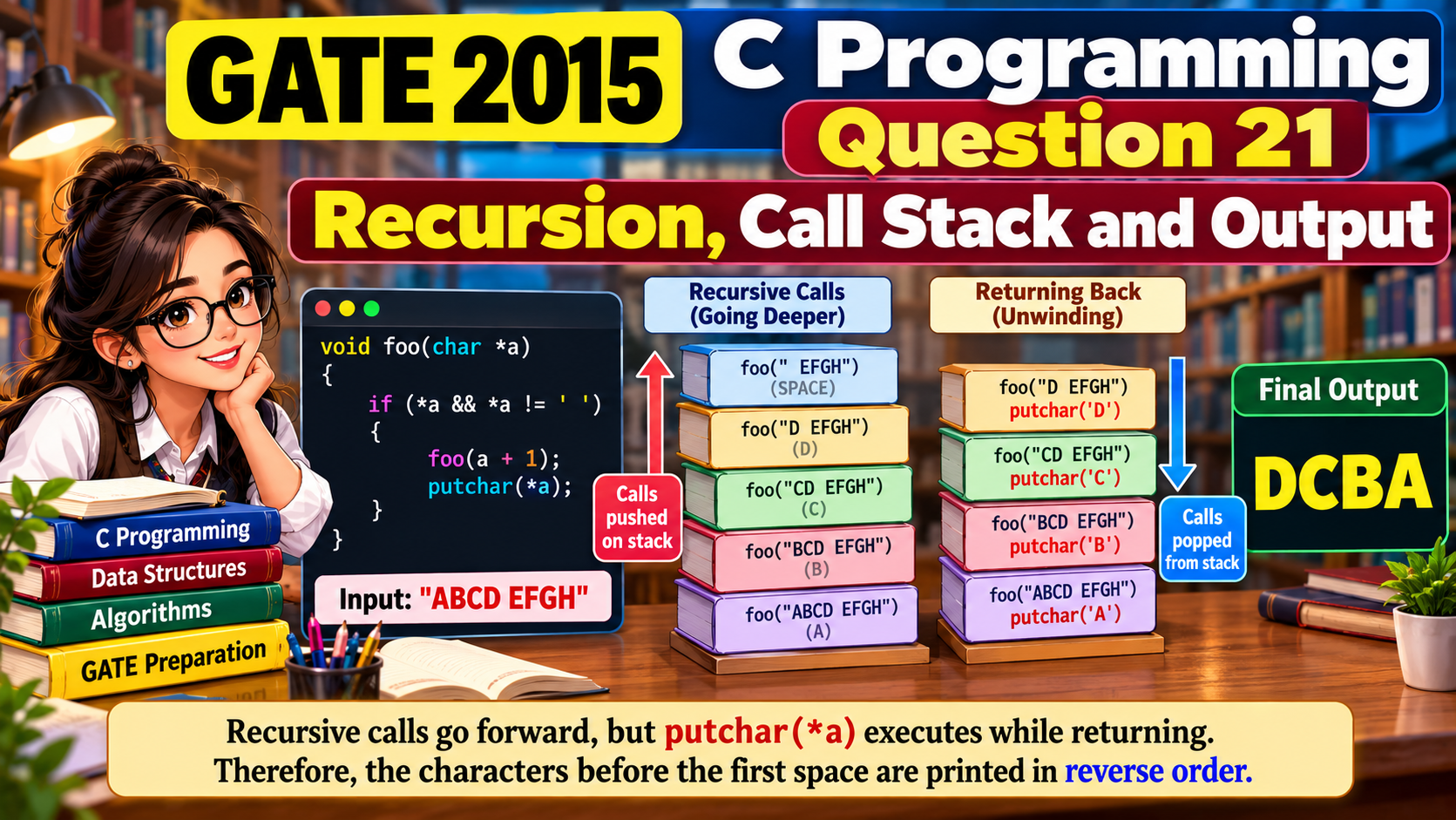
GATE 2015 COMPUTER SCIENCE & INFORMATION TECH. – CS – C Programming | Q. 21 (Session – 2)
💻 GATE 2015 – C Programming | Question 21
Question Type: MCQ | Topic: Recursion and Character Pointers
Consider the following function written in the C programming language:
void foo(char *a)
{
    if (*a && *a != ' ')
    {
        foo(a+1);
        putchar(*a);
    }
}
The output of the above function on the input “ABCD EFGH” is:
(C) HGFE DCBA (D) DCBA
SOLUTION
🔄 What is Recursion?
The given question involves recursion technique. Recursion is a technique in which a function calls itself to solve a problem step by step. Think of a computer searching through a folder and its sub-folders: one folder may contain another folder, which may contain more folders, so the same searching task is repeated for each folder until there are no more folders to explore. Similarly, a family tree contains parents, grandparents, great-grandparents, and so on, where the same idea can be repeated for each generation. In programming, recursion continues solving smaller versions of the same problem until a stopping condition is reached.
💻 Complete C Program – Try It Yourself
The GATE question gives only the recursive function.
To test the program in an online or offline C compiler, we need to add
the required header file, main() function, and input statement.
Copy the complete program below and run it with the input
ABCD EFGH.
#include <stdio.h>

void foo(char *a)
{
    if (*a && *a != ' ')
    {
        foo(a + 1);
        putchar(*a);
    }
}

int main()
{
    char str[100];

    printf("Enter a string: ");
    scanf("%[^\n]", str);

    printf("Output: ");
    foo(str);

    return 0;
}ABCD EFGH
▶️ Output:
DCBA
⚠️ Important:
Notice that the function stops when it encounters a
space character. Therefore, the characters
EFGH are never processed. The interesting part is that
putchar(*a) comes after the recursive call,
so the characters are printed while the recursive calls are returning.
Step by step solution
🧩 Step 1: Understand the Function and Input
Before tracing the recursion, let us first understand what the function
receives and where the pointer a is pointing.
void foo(char *a)
{
    if (*a && *a != ' ')
    {
        foo(a + 1);
        putchar(*a);
    }
}"ABCD EFGH"
A  B  C  D  _  E  F  G  H  \0
^
a
_ represents a space character.
The pointer
a initially points to the first character
A.
Therefore, *a is A.
Since A is neither '\0' nor a space,
the condition
*a && *a != ' '
is true.
The function then executes foo(a + 1). This moves the pointer to the next character. The same process continues for A → B → C → D. When the pointer reaches the space after D, the condition becomes false and the recursion stops.
🔁 Step 2: Follow the Recursive Calls
The function keeps calling foo(a + 1) as long as
*a is not '\0' and is not a space.
Therefore, the pointer moves through the characters
A → B → C → D.
🔎 The condition is:
*a && *a != ' 'For A, B, C and D, the condition is true, so another recursive call is made.
➡️ So the recursive calls occur in this order:
a reaches the space:
*a == ' '
Therefore,
*a != ' ' becomes false.
The if block is not executed, and the recursion
stops here.
📚 What has happened to the call stack?
Each recursive call is placed on the call stack. At the space, no new recursive call is made. The stack has therefore grown up to the call for D.
foo("ABCD EFGH")
    └── foo("BCD EFGH")
         └── foo("CD EFGH")
              └── foo("D EFGH")
└── foo(" EFGH") ← stops hereputchar(*a) has
not printed anything yet. The recursive calls are
made first because foo(a + 1) appears before
putchar(*a) in the function.
🔙 Step 3: Returning from the Recursive Calls
When the pointer reaches the space, the condition becomes false and
that recursive call finishes. The function then starts
returning one call at a time.
Remember that putchar(*a) appears
after the recursive call, so the character is printed
only when that particular recursive call returns.
foo("D EFGH")
putchar(*a);*a is D, so
D is printed.
foo("CD EFGH")
putchar(*a);*a is C, so
C is printed.
foo("BCD EFGH")
putchar(*a);*a is B, so
B is printed.
foo("ABCD EFGH")
putchar(*a);*a is A, so
A is printed.
The reason is the order of the two statements:
foo(a + 1);       /* recursive call */
putchar(*a);      /* executed after recursion returns */
Think about a computer folder containing another folder, which contains another folder, and so on:
↳ 📁 Folder B
↳ 📁 Folder C
↳ 📁 Folder D
You enter A, then go inside B, then C, and finally D. You cannot exit Folder A first because you are still inside Folder B, C, and D. When you start coming back, you must exit Folder D first, then C, then B, and finally A.
Recursion works in a similar way. The last recursive call made is the first one to return. This is called Last In, First Out (LIFO), which is the basic behavior of the function call stack.
🔎 Important Observation
The function never processes the characters after the first space. In this input, the space occurs immediately after ABCD.
When a reaches this space,
*a != ' ' becomes false.
Therefore, the if block is not executed and the
recursion stops completely.
It does not restart after the space.
🎯 Final Output
-
foo(a + 1)moves forward through the string. -
putchar(*a)executes while coming back from recursion. - Therefore, the characters before the first space are printed in reverse order.
🖨️ What is putchar()?
putchar() is a C library function
used to print one character on the screen. In our
program, putchar(*a) prints the character currently
pointed to by the pointer a.
putchar(character);putchar('A');Output: A
putchar(*a);
Here, *a means
the character stored at the location pointed to by
a. Therefore, if a points to
A, putchar(*a) prints A.
If it points to D, it prints D.
putchar(*a) does not execute immediately.
It comes after the recursive call
foo(a + 1). Therefore, the program first moves forward
through the string and only then prints the characters while returning
from recursion.
🔴 Every recursive solution must have a
BASE CONDITION
to stop the recursion.
if statement. Other control mechanisms can also be used.
However, for beginners, if is the most common and
easiest way to express the stopping condition in a recursive function.
Library Books Stack Analogy to understand Recursion
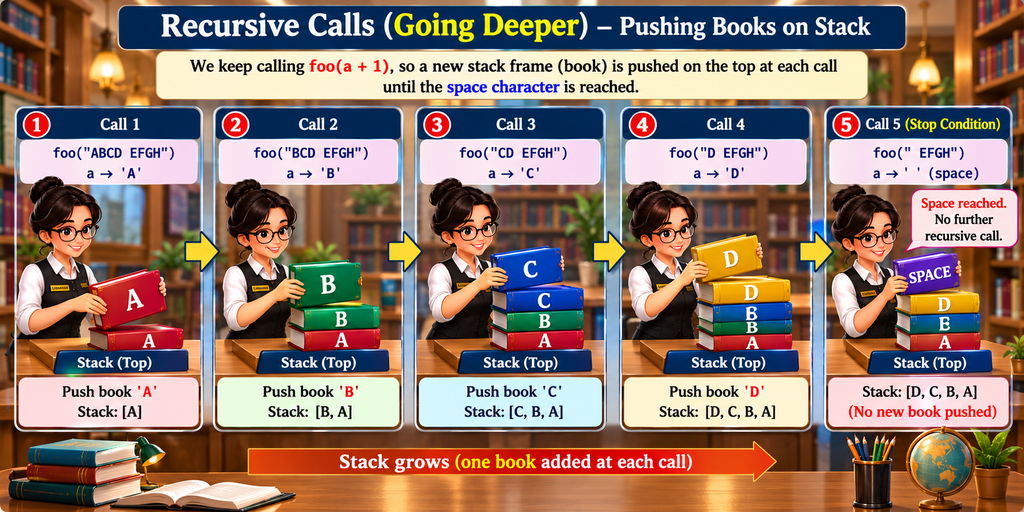
🧠 Understanding Recursion Using a Stack
When a function calls itself, the computer creates a new
stack frame for that function call. In our
foo() function, each recursive call moves the pointer
one character forward. The calls continue until the
pointer reaches the first space character.
📚 Think of a Stack
Think of a stack of books or plates. A new item is placed on the top. When removing items, the item placed last must be removed first. The same idea is used by the function call stack.
💻 Our Recursive Function
void foo(char *a)
{
    if (*a && *a != ' ')
    {
        foo(a + 1);
        putchar(*a);
    }
}
🔽 Step 1: Going Deeper
The input is:
ABCD EFGH.
The pointer starts at A. Since A is not a space
and is not '\0', the function calls
foo(a + 1).
Thus, the function keeps going deeper through A, B, C and D.
📦 Step 2: Stack Frames Are Created
Each recursive call creates a new stack frame:
foo("ABCD EFGH")      ← A
    foo("BCD EFGH")   ← B
        foo("CD EFGH") ← C
            foo("D EFGH") ← D
                foo(" EFGH") ← SPACE
At the space, the condition becomes false. Therefore, no further recursive call is made.
🛑 Important Point: Recursion Stops at the Space
When a points to the space,
*a != ' ' becomes false.
The if block is skipped and the recursion stops.
The function does not continue to EFGH.
🔄 LIFO — Last In, First Out
The last recursive call made is the first call to return. This is the Last In, First Out (LIFO) behavior of the function call stack.
C → returns next
B → returns next
A → returns last
🔙 Step 3: Returning Back
Now the recursive calls start returning. Only now does
putchar(*a) execute.
Return from D → putchar('D') → D printed
Return from C → putchar('C') → C printed
Return from B → putchar('B') → B printed
Return from A → putchar('A') → A printed
🎯 Final Output
💡 A Simple Way to Remember
-
foo(a + 1)→ goes forward through the string. - The first space → stops the recursion.
-
putchar(*a)→ executes while coming back. - Therefore: Go forward A → B → C → D and come back D → C → B → A .
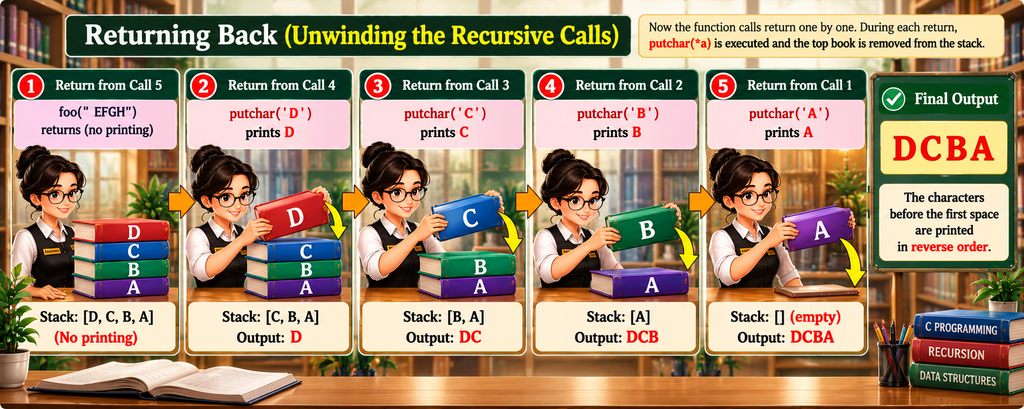
🔄 Returning Back: Unwinding the Recursive Calls
The recursive function has reached the space character,
so it cannot make another recursive call. Now the function calls begin
to return one by one.
During each return, putchar(*a) is executed.
📚 Think about our stack of plates
Each recursive call added a new frame to the top of the call stack. Now we start removing those frames from the top. The last call added is the first call to return. This is the LIFO (Last In, First Out) rule.
🛑 First, the space is reached
foo(" EFGH")
Here *a is a space, so
*a != ' ' is false.
The if block is skipped and this function call
returns immediately.
🔙 The calls now return in reverse order
foo(" EFGH")  → returns
foo("D EFGH") → putchar('D') → prints D
foo("CD EFGH") → putchar('C') → prints C
foo("BCD EFGH") → putchar('B') → prints B
foo("ABCD EFGH") → putchar('A') → prints A
📚 What happens to the stack?
The top stack frame returns first. Then the next frame returns, followed by the next one, until the original call finally returns.
Notice that the space does not get printed. Its function call simply returns because the condition is false.
🔁 Going Deeper → Reaching the Space → Returning Back
Unwinding: SPACE → D → C → B → A
putchar(*a)
prints the characters in reverse order: